
Parshat Noach
Download PDF PDF in French Share your feedback

This week I did not add an insight of my own to the sheet. I let our teachers speak, I checked their facts, and wherever a fact or a source needed correcting I put a short note under the point itself. But as I read them side by side, one picture kept coming back to me: a family inside a wooden box, floating over a drowned world, waiting for the day they could step out and build again. That is what I would like to talk about before we learn.
Let me first retell the parshah in a few lines. The world is full of violence, and Noach is the one righteous man left, so Hashem tells him to build a Teivah (ark). Noach, his family and the animals go in, and the Mabul (Flood) covers the earth. When the waters recede, the dove comes back with an olive leaf, and after a full year they leave the Teivah. Hashem promises there will be no more floods, gives humanity its basic laws, and sets the rainbow as the sign of His covenant. Then people build Migdal Bavel (the Tower of Babel). Their languages are confused, they are scattered, and the parshah ends with the generations that lead to Avram.
The Rebbe does not let us read the Mabul only as a punishment. Building on the Alter Rebbe’s Torah Or, he teaches that it cleansed a world “sullied by strife, corruption, and violence,” and that it lasted 40 days to match the 40 se’ah of a mikveh. Yeshayahu calls it “the waters of Noach,” from nachas, tranquility. Then the Rebbe brings it home. The “abundant waters” of our own lives, above all the worries of making a living, are meant in the end to wash us clean: “Ultimately, these ’abundant waters’ cleanse a person of his undesirable traits, enabling him to attain tranquility and contentment.” What moves me most is his reassurance that such a cleansing “need not be a lengthy one; it can be accomplished in a brief moment,” once we understand what it is for.
Where do we go when the waters rise? The Baal Shem Tov answers with the word Teivah, which means both “ark” and “word.” Enter the words of Torah and prayer, let them surround you, and “even under the direst of circumstances” you will not be swept away. The Rebbe makes it practical: Modeh Ani and the morning blessings, said by someone who knows that all existence is renewed every moment. And after real prayer, he says, the burden of proof changes sides. When the yetzer hara argues that something is a necessity, the answer is “Bring proof!” As the chassidic saying goes, “What is forbidden is forbidden, and what is permitted is superfluous.”
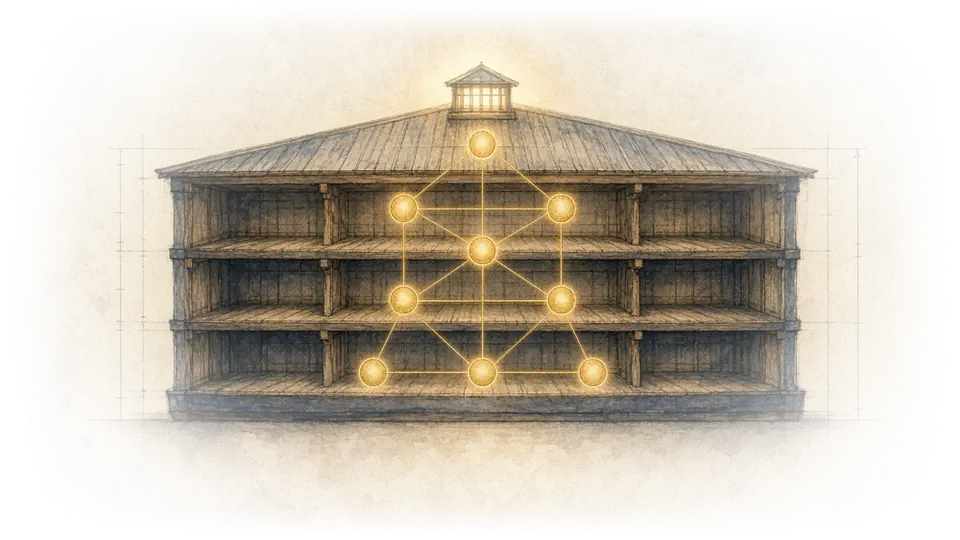
Rav Dynovisz looks at the same Teivah through Kabbalah. Why would the Torah give its exact measurements, details any sensible builder could work out alone? Because, he says, the whole structure of the sefiros is hidden in the Teivah: the 300 amos stand for the three upper sefiros, the 50 for the fifty gates of Binah, the 30 for the three that come down from it. And he insists that in every catastrophe some are saved by grace, even when we cannot see why: « la rétribution ne se fait absolument pas selon notre compréhension à nous ».Translation: “reward and punishment do not work at all according to our own understanding”
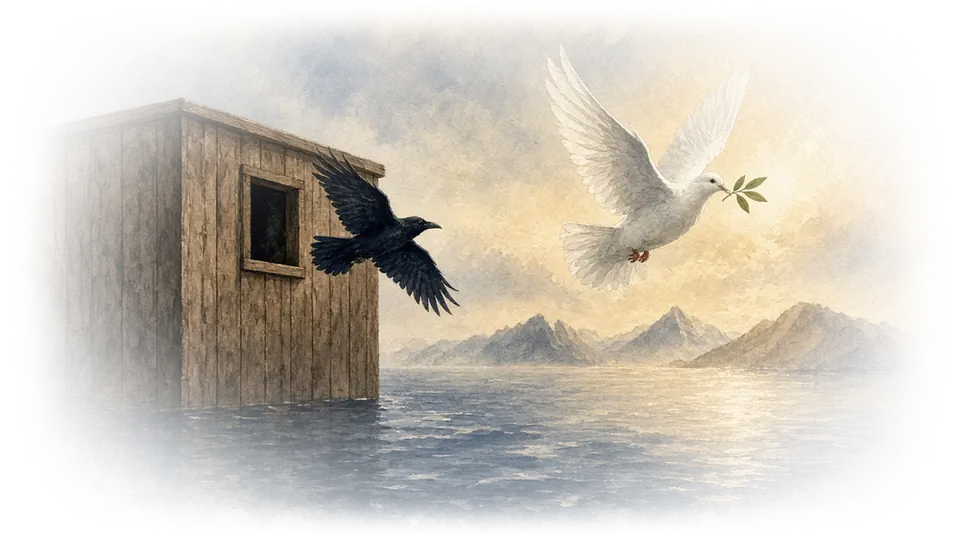
Rabbi YY Jacobson asks why Noach sent out the raven before the dove. The raven stands for gevurah, sternness, and the dove for chesed, kindness. After a world that had been “spoiled rotten,” Noach first thought the new world needed toughness, and he learned that “with a raven you can’t rebuild a world.” The raven keeps its place at the edges, setting limits, but “the primary driving force in life must be love loyalty compassion trust.” People who have been flooded by pain often grow a raven’s shell, and who can blame them? Yet Rabbi Jacobson points to the survivors of the Shoah, who had every reason to become ravens and instead built homes full of love: “after the flood you can still send out a dove.”
Rabbi Manis Friedman sets the Mabul beside Migdal Bavel. The generation of the Mabul was “okay with G‑d, not good with each other,” and it was removed from the earth. The builders of the tower were “okay with each other, not so good with G‑d,” and they were only scattered. Being good to people, he says, is what earns us our place on earth, and after the Mabul the free ride was over: “people are going to have to earn their keep... partner with G‑d.” I take comfort in another line of his. Of that whole generation “only eight were good,” and that never happened again, because “good people don’t get attention because good is normal and normal doesn’t get attention.”
Rabbi Reuven Wolf, teaching the Ropshitzer, asks why the verse calls Noach perfect “in his generations,” in the plural. Because a tzaddik’s service reaches every potential in his soul, including his descendants, who then find it “much easier to connect.” The first letters of נח איש צדיק תמים add up to 541, the value of ישראל. As he puts it, “it’s not just you it’s your children your grandchildren great-grandchildren.” With the Rambam, he asks us to see the world, and ourselves, as exactly balanced, so that one act can tip everything. Noach did not finish the repair; Avraham did. But Noach tipped the scale back toward Hashem.
When I put these together, I see the shape of the week. The waters come, and they are meant to cleanse, not to destroy. We take shelter in the words of Torah and prayer. And when we step out, we rebuild with the dove in front, being good to the people around us, knowing that one good act can tip the world and that our children’s children will build on what we do. A Chabad.org essay printed with the Rebbe’s section (not the Rebbe’s own words) adds one more step: building a Teivah is needed, “but this is not the final goal. The true aim is to change the world.”
The Mabul itself points to the end. The Zohar reads the six hundredth year of Noach’s life, when the springs of the deep burst open, as a hint to the six hundredth year of the sixth millennium, when wisdom from above and from below would pour out “to prepare the world to enter the seventh millennium.” The Rebbe saw in the radio, which carries a voice instantly “to the very ends of the earth,” a foretaste of the promise that “all flesh will see.” Rav Dynovisz says that at the Redemption « les nations vont atteindre un niveau inimaginable », and Rabbi Wolf traces Terach’s family through Lot, Moav and Ruth to David and Mashiach. May whatever waters we face this week wash us clean in “a brief moment,” may we always send out the dove, and may we very soon see the world filled with knowledge, with the arrival of Mashiach, may it be today.Translation: “the nations will reach an unimaginable level”
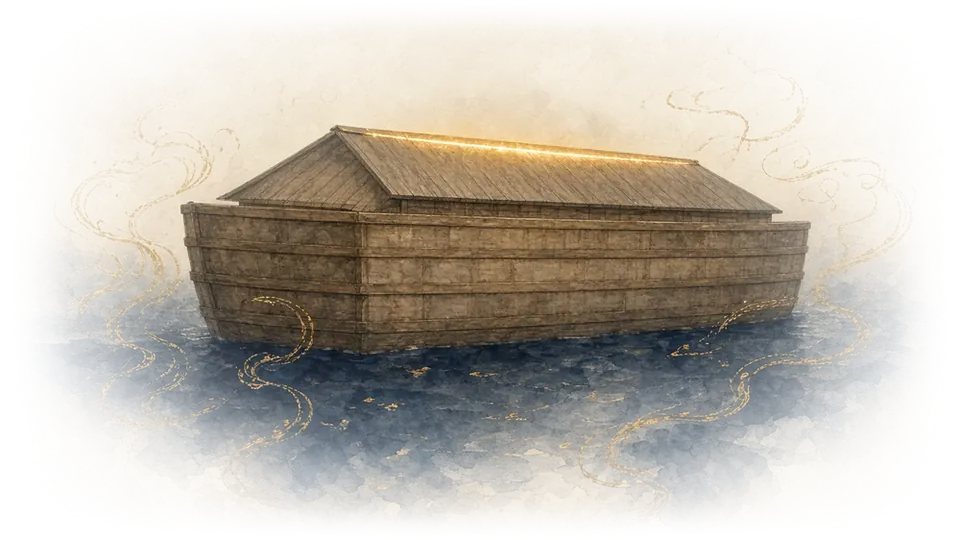
The Mabul (Flood) as a mikveh: purification, not just punishment (LS 1, §1)
The Rebbe builds on the Alter Rebbe (Torah Or 8c ff.). The Mabul cleansed a world “sullied by strife, corruption, and violence.” That is why it lasted 40 days, matching the 40 se’ah of a mikveh, and why Yeshayahu (54:9) calls it “the waters of Noach,” from nachas, tranquility. Torah Or then applies this to the “abundant waters” of Shir HaShirim 8:7, the worries of earning a living. These “cannot quench the love,” and in the end they cleanse.
“Ultimately, these ’abundant waters’ cleanse a person of his undesirable traits, enabling him to attain tranquility and contentment.”
Tevilah = habitul: financial pressure breaks the ego (LS 1, §2–3)
The inner point of a mikveh is bittul. Rambam speaks of immersing “in the waters of pure knowledge,” and טבילה has the same letters as הביטל. Money worries serve the same purpose. They may upset a person and leave him “crestfallen,” but in the end they break his egocentricity. Since the aim is cleansing and not punishment, it “need not be a lengthy one; it can be accomplished in a brief moment,” once he grasps the inner intent.
“Even though they may temporarily upset and confound him, causing him to be crestfallen, ultimately they will break his egocentricity.”
Two sources of the Mabul: “the depths” and “the windows of heaven” (LS 1, §4)
The floodwaters came from below (“the awesome depths”) and from above (“the portals of heaven,” Bereishis 7:11). So do our distractions. Some are material, like livelihood. Others are lofty, like communal work. When communal work crowds out the Torah study and mitzvos the Shulchan Aruch requires, the Rebbe says the excuse comes from the animal soul. Left alone, “the portals of heaven” slide down to “the awesome depths.”
“If, however, that connection is lacking... of what value are all the praiseworthy activities in which he is involved?”
The Baal Shem Tov’s Teivah (ark): “enter the ark” (LS 1, §5)
Teivah means both “ark” and “word.” The Baal Shem Tov teaches that one should enter, and be surrounded by, the words of Torah and prayer. Then “even under the direst of circumstances” one is not swept away. In practice that means starting the day with Modeh Ani and the morning blessings. Why bless Hashem “Who clothes the naked” when you own clothes? Because the wise man “sees what is being born”: all existence is renewed every moment. The Rebbe compares this to the Zohar’s Rav Yeisa the Elder, who prayed for his food even though it was already on the table.
“What is forbidden is forbidden, and what is permitted is superfluous” (LS 1, §5 cont.)
Before prayer, one assumes the world is primary, and that colors everything: whatever is permitted is fine, and when in doubt it is permitted. The Rebbe borrows the halachic rule of chazakah (presumption): “the burden of proof rests on the one who seeks to expropriate.” After real prayer, the presumption flips. Only Hashem truly exists, so every worldly indulgence needs a reason. When the yetzer hara argues that something is a necessity, the answer is “Bring proof!”
“This outlook explains a classic chassidic expression, ’What is forbidden is forbidden, and what is permitted is superfluous.’”
The Zohar’s “year 600” and the two floods of wisdom (LS 15, Noach 2, §1–2)
“In the six hundredth year of Noach’s life... the wellsprings of the deep burst and the windows of heaven opened.” The Zohar (I:117a) reads this as a prophecy: “In the six hundredth year of the sixth millennium” (which began in 1839), supernal wisdom (Torah, especially its inner dimension) and lower wisdom (secular knowledge) would burst forth “to prepare the world to enter the seventh millennium.” The Rebbe cites the Tzemach Tzedek on 5608 (1847–48), a year once proposed for Mashiach: it was the year Likkutei Torah was published. Two axioms follow. Everything was created “for the sake of the Torah and for the sake of the Jewish people” and “for His glory,” so secular knowledge exists to serve Divine service.
The Rebbe adds a strong caveat. This has “no connection” to whether young people should attend college or university, which he calls “a severe prohibition... fraught with danger.”
“the year 5608 (1847–1848) was mentioned as one of the appointed dates for Mashiach’s arrival, he gave the well-known response that Likkutei Torah was published that year.”
The radio lesson: “an Eye that sees and an Ear that hears” (LS 15, Noach 2, §4–5, 7)
One Messianic promise is that “all flesh will see” (Yeshayahu 40:5), meaning physical sight of Hashem’s word. Technology gives a taste of it. If a voice can be heard instantly “to the very ends of the earth and even on the moon,” and a person can be seen as well, how much more is everything we do seen and heard Above (Avos 2:1; Tehillim 94:9)? Radio used to spread Chassidus is a foretaste of “the world will be filled with knowledge.” The Rebbe notes that radio waves fill every place, receiver or not.
“everything that a person does, even in the most secret of places, is instantaneously perceived by ’the Eye that sees and the Ear that hears.’”
Unity in creation and achdus Hashem (LS 15, Noach 2, §8)
Using science as a tool is one level. Finding Torah truths within science is higher. Physics once saw separate forces and many elements. Now it sees existence as “a dynamic unity between two components: mass and energy,” which echoes Hashem’s simple oneness. True oneness belongs to Hashem alone, so a created thing can only reflect it as a union of two. (The translator’s note cites Ibn Ezra: Creation begins with a beis.)
“The true unity between secular knowledge and the Torah is expressed when the former itself demonstrates the truths of pnimiyus haTorah.”
Supplementary (not the Rebbe’s words): Noach versus Avraham, and the soft wood
- Loewenthal, citing the Rebbe’s LS 2 p. 452 and Zohar III 15a: Noach built a holy Teivah but “did not try to save everyone else.” That is why Yeshayahu calls the Mabul “the waters of Noah,” as though he were responsible. “Build an Ark” is a needed skill, “but this is not the final goal. The true aim is to change the world,” as Avraham did for Sodom.
- Weisberg: gopher wood is “soft and able to withstand the pressures,” while pitch makes it “impenetrable.” Be flexible in temperament and firm in principle (Taanis 20b: “better to be as soft as a reed than as hard as a cedar”).
Chana Weisberg, “Dealing With the Flood of Life,” Chabad.org — not the Rebbe’s own text · chabad.org/…/aid/3794923
Elokim and Havayah: strict justice and grace; the Shoah as a “flood” (00:00–07:00)
Recap of the first class: Hashem judges at two levels. Elokim is strict justice, Havayah is grace. Noach would have died under Elokim, but he was just enough for grace to rest on him; his generation did not merit even Havayah. In every catastrophe, some are saved under Havayah, and paradoxical blessings follow. During the Shoah, while European Jewry burned, other Jews, some « qui ne respectaient même pas shabbat », were farming the land and preparing the State. Who goes under which Name is beyond us: « la rétribution ne se fait absolument pas selon notre compréhension à nous ».Translation: “who did not even keep Shabbos” · “reward and punishment do not work at all according to our own understanding”
The nations will never vanish; Amalek “the excrement-nation” (07:00–10:43)
Because the principle is revealed through Noach, father of the 70 nations, « aucune des nations ne disparaîtra totalement ». Even an atomic war will not wipe them out; all 70 will bring offerings at Sukkos after Gog. Only Amalek, the “71st,” is meant for total destruction, like a foreskin, an overgrown nail, or « à Malek est un peuple excrément ». « il ne vit que de méchanceté de destruction ». It is an ideology, not a people: today it rules Persia (Tiras, one of the 70, will not disappear), and in the past it was in Germany.Translation: “none of the nations will disappear completely” · “Amalek is an excrement-nation” · “it lives only on wickedness and destruction”
The Teivah’s measurements make no sense without Kabbalah (11:16–20:23)
He reads Bereishis 6:13–16 closely: gopher wood, compartments, pitch, 300 × 50 × 30 amot (about 150 × 25 × 15 m), the window, a roof that rises but ends in a flat strip one amah wide, a door in the side, and three decks. « qu’est-ce qui lui prend bon D.ieu de donner des détails aussi » précis? Any sensible builder could work this out alone, and once written in the Torah the measurements become absolute. He says no plain commentary explains them. Only the masters of the secrets reveal that « dans l’arche de Noé se cache toute la structure » of the sefiros.Translation: “what has come over Him, good heavens, to give such details” · “the whole structure is hidden inside Noach’s Teivah”
Elokim = ha-teva (nature); the Mabul’s sins; the homosexuality excursus (20:23–31:27)
- Noach and Binah: Noach was saved by rising to Binah, the first of the three upper sefiros, which work above nature.
- Elokim = nature: « le mot éloquine désigne D.ieu lorsqu’il dirige le monde à l’intérieur de l’espace-temps », and its numerical value equals הטבע (nature).Translation: “the word Elokim refers to Hashem as He runs the world within space and time”
- The Mabul’s sins: the generation’s sins were male–male, female–female and human–animal relations. He mocks the Jerusalem pride parade: the next parade will be « des défilés homme chienne et femme chien », with family allowances.Translation: “parades of man–dog and woman–dog”
- The excursus: opposing homosexuality on religious or moral grounds is « complètement faux ». A gay person, mostly born that way (« pour la plupart d’entre eux »), feels more moral loving his partner, so, from that perspective, those who condemn him are the ones who seem “abominable.” The real issue is nature and the continuation of the world: such unions « commettent un crime non contre D.ieu mais contre la nature ».Translation: “completely wrong” · “for most of them” · “commit a crime not against Hashem but against nature”
- His limits: « et donc très bien je vais pas te brûler ». He rejects burnings and camps, but says claiming normality « c’est consciemment ou non revendiquer la fin du monde ».Translation: “so, very well, I’m not going to burn you” · “is, consciously or not, demanding the end of the world”
- Why the world was destroyed: for that “self-destruction,” with Elokim/nature merely signing off on it. Debauchery between men and women, he says, would not destroy a world.
The upper sefiros and the 13 attributes of mercy; WWII rescues (31:27–38:54)
The 13 attributes revealed to Moshe after the golden calf come from Keser, Chochmah and Binah. When a tzaddik attaches himself to at least Binah, that light floods the world and saves it. The Shoah was a typical “flood.” He says « on approche les 8 millions de Juifs morts dans les camps de concentration » and that 6 million was kept as the official figurea. At the same moment “many Noahs” were saved, and the Torah world was rebuilt in the US and Israel. His miracle examples:Translation: “we are approaching 8 million Jews who died in the concentration camps”
- The Rebbe Rayatz’s escape from besieged Warsaw to America « en passant par Berlin », which he says no one understands: « ça c’est un sauvetage du type Keter »b.Translation: “by way of Berlin” · “that is a Keser-type rescue”
- Rommel’s inexplicable halt before he reached Eretz Israel.
Noach’s name: nun = the 50 gates, ’het = 8 (Binah); ’hen = Noach reversed (38:54–40:28)
נח: nun (50) stands for Binah’s 50 gates, and ’het (8) for Binah as the 8th sefirah counting up from Malchus. Reversed, the same letters spell חן (grace). Noach was “destined” to draw down Binah’s grace.
Units, tens, hundreds: three depths in each sefirah (40:28–58:40)
Each sefirah contains 10, and each of those 10 more, so 100. The Torah stops at three levels, like the core family of father, son and grandson (laws of testimony and incest). He gives two analogies:
- Marriage, children, grandchildren: marriage is the surface of happiness, children are depth, grandchildren the deepest. Few men see grandchildren, and great-grandchildren are a gift from heaven. A sefirah at 100 is like a man whose life is in danger and finds hidden powers: « dans chaque tartan pion [Tartempion, “Joe Bloggs”] en vérité il y a un héros potentiel ».Translation: “in every Joe Bloggs there is, in truth, a potential hero”
- The lost glasses case: in plain sight (units), somewhere in the room (tens), lost who knows where (hundreds). He ties this to the halakhah of yeush on lost objects with no identifying mark.
So the Teivah’s 300 (hundreds), 50 and 30 (tens) and 1 amah (unit) stand for sefiros shining fully, moderately and only on the surface. These are the forces that saved the Jews in the Shoah and will save them in the war of Gog, « qui a déjà depuis fort longtemps commencé ».Translation: “which already began a very long time ago”
Sefiros as keys of perception beyond the brain; Moshe in Rabbi Akiva’s class (03:16–12:19)
Brilliance alone doesn’t give spiritual insight; one can be a towering intellect and still understand nothing of the Torah. The great masters perceive through ruach ha-kodesh connected to a particular sefirah. Moshe, sitting in Rabbi Akiva’s class (Menachot 29b), was reassured by the phrase “halakhah le-Moshe mi-Sinai” (the captions garble it, e.g. « à la Halle emocher Miss Sinaï »). “Mi-Sinai” means Akiva drew from the same place Moshe did: Sinai, the code that holds all the sefiros.Translation: “a halachah given to Moshe at Sinai (halachah le-Moshe mi-Sinai)”
Three levels of perception: what happened, why, and gilgulim; magic as illusion (12:19–32:18)
- Unit: honestly taking stock of one’s life, which most people never do (« la majorité ne sont même pas branchés au sirop unitaire »), even with « 20 diplômes de la Sorbonne ».Translation: “most of them are not even connected to the [sefirah] unit” · “20 degrees from the Sorbonne”
- Tens: understanding why, through self-improvement and prayer.
- Hundreds: understanding one’s life through past lives, « qui est tout simplement mon guilgoule mais réincarnation ». This is prophecy (nevua). The Arizal saw everyone’s gilgulim, and Yisro taught Moshe this kind of discernment (“ve-ata te’hezeh”); he cites the Zohar.Translation: “who is simply my gilgul, my reincarnation”
- Audience question on mediums: the Torah forbids magic because it is a convincing counterfeit; « rien n’est plus vrai qu’une illusion mais ça reste une illusion ».Translation: “nothing is more real than an illusion, but it is still an illusion”
Mapping the Teivah onto the sefiros: 300 / 50 / 30 (32:18–55:25)
- 300 (length) = Keser, Chochmah, Binah: « Noah était au niveau même des centaines ». Length also means time: « Noah a tout compris c’est un prophète inimaginable ». Noach traced his generation’s corruption back to Adam’s sin and saw forward to Mashiacha.Translation: “Noach was at the very level of the hundreds” · “Noach understood everything; he is an unimaginable prophet”
- 50 (width) = Binah: Binah’s 50 gates are 5 soul levels (nefesh to yechidah) × 10. The word “light” appears 5 times on day one.
- Age as a ladder through the upper sefiros: « à 40 ans on arrive à la porte de la Bina ». Then 50–60 is Chochmah and 60–70 is Keser (hence the 70 years of Tanach). From 70 to 120, the light shines outward. That’s why Kabbalah study traditionally starts at 40.Translation: “at 40 one reaches the gate of Binah”
- Noach and Avraham: Noach was a giant, « l’un des maîtres principaux de qui de Abraham ». « ça peut être que 52 ans leurs années se sont croisés »b. The Noahide nations come from a source high enough to have taught Avraham, and at the redemption « les nations vont atteindre un niveau inimaginable ».Translation: “one of the main teachers of — of whom? — of Avraham” · “maybe 52 years: their years overlapped” · “the nations will reach an unimaginable level”
- 30 (height): « dans le monde furotique quand on descend on monte »: the stronger a light, the higher it must be rooted to reach the darkness. So the height of 30 encodes the three sefiros that come down from Binah: Chesed, Gevurah, Tiferes. This is « la preuve absolue » that Kabbalah is written in the Torah of Moshe. He stops there, exhausted; the mapping was to continue in the next class.Translation: “in the world of the sefiros, when you go down you go up” · “the absolute proof”
The story and three questions (~01:24–06:44)
After 40 days, Noach opens the window and sends out the raven, which “kept going and returning until the waters dried.” Then he sends the dove three times. The first time it finds no rest. The second time it returns with a plucked olive leaf. The third time it doesn’t return. Jacobson asks three questions: Why two birds? Why these two (the Netziv notes that other birds are faster)? Why this order? He will answer “based on the works of kabbalah and hasidus.”
“it would seem as if the raven did its job admirably and successfully and the story should have ended right here” (~02:29)
The raven’s reputation (~06:44–13:50)
He describes the raven through:
- Its features: black feathers, croaking call, diet of carrion.
- Tehillim 147 and the Ibn Ezra: Hashem feeds “the children of the raven which call out,” because, the Ibn Ezra reports, “scholars among the gentiles” say raven parents abandon their chicks. Jacobson says this is one reason it is a non-kosher bird.
- Later culture: Poe’s poem and the Tower of London ravens.
- The Be’er Mayim Chaim: עורב reads as “bo ra,” “there is negativity in him.”
- Sanhedrin 108b: the raven was one of three (with Cham and the dog) that had relations in the Teivah despite the ban.
“there are scholars among the gentiles who say that their parents abandoned them after birth” (~08:30)
The dove: loyalty (~13:50–16:15)
The dove stands for tenderness and loyalty. Shir HaShirim Rabbah explains “your eyes are like doves”: once a dove recognizes its mate, it never substitutes another. Israel, too, never exchanged Hashem despite every invitation to idolatry. The dove is also kosher, and it was used on the Temple altar.
“once the jews recognized G‑d they would never substitute them with anybody else” (~15:40)
Raven = gevurah, dove = chesed (~16:15–16:47)
In Kabbalah, the raven is gevurah (sternness) and the dove is chesed (kindness). The order of the birds is the key to the story.
“the raven represents gevorah aggression strength sternness” (~16:15)
Noach’s first theory: the world needs toughness (~16:47–19:51)
Noach reasoned that humanity had been “spoiled rotten.” Too much love and abundance bred narcissism and depravity. So the new world order should be “sternness strength discipline harshness.” Jacobson compares this to addiction: kindness without boundaries can make you an enabler.
“humanity nayach felt received too much love too much nurture too much affection” (~17:17)
The Mabul inside us: growing a raven’s shell (~19:51–22:25)
In our own lives, people who have been “flooded” by pain, disappointment or betrayal often rebuild as ravens. They grow “a rough shell a dark plumage,” and become cynical and suspicious. “Can we blame them? They are afraid to be abused again.”
“they develop a rough shell a dark plumage a dense crust an aggressive disposition” (~20:53)
The raven patrols the edges; the dove must lead (~22:25–25:40)
Noach learned that “with a raven you can’t rebuild a world.” The raven has a place on the periphery: “going and returning,” setting limits on love so that kindness doesn’t turn self-destructive or let “bad people get away with murder.” But love must lead the settlement. This applies to anyone let down by parents, siblings or friends.
“the primary driving force in life must be love loyalty compassion trust” (~23:28)
The survivors who sent out the dove (~25:40–31:33)
“A flood which destroyed a third of our nation... one and a half million children.” Survivors had every reason to become ravens toward their families. Instead, “a miracle”: most built homes full of love and opportunity. He acknowledges “the paralyzing silence” in many of those homes. He tells of an Auschwitz survivor who raged at the sun for rising over the camp, then thanked it the morning after liberation.
“they replaced the raven with the dove or at least they allowed the dove to follow the raven” (~26:42)
“after the flood you can still send out a dove” (~29:53)
Only eight good people, and why bad gets the headlines (~00:00–02:43)
Of the whole population, “only eight were good,” which Friedman calls something that never happened again. Normally the world is at least “50-50,” and really “more good people than bad.” Bad people “get all the press,” and he calls that “a compliment” to humanity: good is normal, and normal isn’t news.
“good people don’t get attention because good is normal and normal doesn’t get attention” (~01:39)
Humanity’s toddler stage: fine with Hashem, bad with each other (~02:43–06:08)
The early generations were “going through their toddler stage.” Hashem was obvious to them (“G‑d created our grandparents”), so belief wasn’t the problem. The problem was each other, like Kayin and Hevel, who both worshipped Hashem and couldn’t get along. Their sins were robbery, sexual “experimentation” (“even the animals were... cross-breeding”), and not respecting “ownership, privacy, independence.”
“there was no problem with G‑d the problem was with each other” (~04:19–04:57)
Clever, but not yet socially skilled (~06:08–07:15)
“These were very smart people.” Noach invented the plow, a grandparent invented musical instruments, and “they even had birth control.” What took a thousand years was learning to live together.
Mabul and Bavel: two kinds of confusion, two punishments (~07:15–10:05)
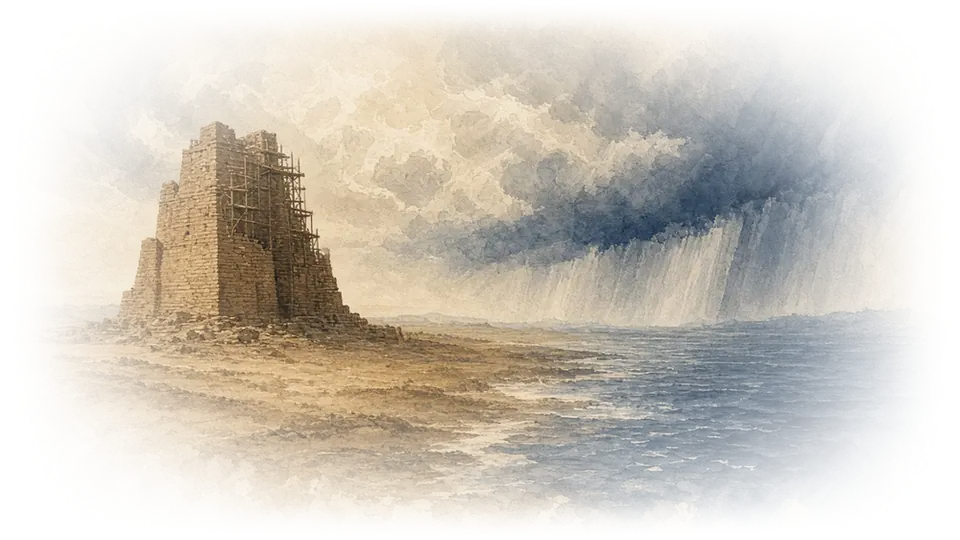
Mabul (Flood) connotes mixing and confusion, which recalls Bavel. The Mabul generation was “okay with G‑d, not good with each other,” and was removed from the earth. The Bavel generation was “okay with each other, not so good with G‑d.” Their cooperation let them build a tower to heaven. They were only scattered and divided by language.
“first Millennium okay with G‑d not good with each other the second Millennium okay with each other not so good with G‑d” (~08:56)
Good with Hashem or good with people? (~10:05–11:42)
“If you had to choose,” being good with people earns you a place on earth. “If you’re not good to each other even if you’re good with G‑d, well then why are you here? ... Go to heaven.” The Mabul was the world’s mikveh: 40 days for the 40 se’ah, until even the mountains were covered.
“if you’re not good to each other even if you’re good with G‑d well then why are you here” (~10:05)
After the Mabul, life is earned (~11:42–13:53)
Before the Mabul, the world ran on pure kindness, the way babies are given everything for free: 900-year lifespans, giant animals, oversized vegetables. After it, “120 years is a human lifespan,” and “people are going to have to earn their keep... partner with G‑d.”
“the flood marked a shift from now on people are going to have to earn their keep” (~13:17)
“Righteous in his generation” versus Avraham, who has no title (~13:53–21:22)
Some Sages read “in his generations” as praise: righteous against the whole world. Others read it as a limit: in Avraham’s time he would be “nothing.” Friedman says both are true. In Noach’s day the question was “good boy or bad boy,” and Noach passed. With Avraham something higher opened up: “Come with Me, be Mine,” being chosen. Next to that, righteousness alone “meant nothing.” That is why Avraham is introduced with no description at all. As trivia, Avraham was 58 when Noach died. Today we can do more than be righteous: we can partner with Hashem in making the world His dwelling.
“once you’re 20 years old being a good boy is embarrassing now you should be a partner in your father’s business” (~19:16)
A new series, and who the Ropshitzer was (~00:02–07:25)
Wolf grew up in a dynasty that descends from Ropshitz, and he feels “a special affinity.” R. Naftali was a student of the Chozeh of Lublin and the Noam Elimelech. He is famous for his wit, but he was also a great Kabbalist; he asked for his tombstone to call him singular in his generation in the concealed wisdom. (The captions garble the Hebrew phrase as “it was a yakito,” so it is not reconstructed here.) Wolf says R. Naftali was born on the day the Baal Shem Tov died, Shavuos [5]520.
“he was enormously witty sharp and a man of absolute truth” (~03:17)
“Tamim haya b’dorosav”: why “generations,” plural? (~07:56–11:08)
Rashi brings the two familiar readings of “in his generations” (praise or limit). The Zera Kodesh, following a question of the Alshich, asks something sharper: why the plural? In those days a generation spanned a whole long lifetime.
“what does it say in his generations in his generation he’s one generation” (~09:30)
A tzaddik infuses his descendants (~11:08–19:45)
The Zera Kodesh answers that when tzaddikim serve Hashem, the service permeates “every potential that there is in their soul,” including the future souls of their descendants. Those descendants then find it “much easier to connect.” The hint: the first letters of נח איש צדיק תמים (נ-א-צ-ת) total 541, the value of ישראל. The seed of Israel was already in Noach. Wolf’s lesson for anyone who feels “done”:
“noah incorporated inside of him all future generations” (~18:40)
“sometimes we think you know it’s just me it’s not just you it’s your children your grandchildren great-grandchildren” (~19:15)
“Tamim tihyeh im Hashem Elokecha”: aligning the spark with its Source (~19:45–29:24)
The Ropshitzer’s second teaching reads “Elokecha,” “your G‑d,” as each person’s own spark of Hashem (Tanya ch. 2: “a part of G‑d above”). Tamim means fusing that spark back into the Infinite, like a drop returned to the ocean. Wolf connects this to Tanya’s Iggeres HaTeshuvah: the higher teshuvah returns “the breath to the Breather” while still alive. Our thoughts, speech and deeds become Hashem’s own, through Torah, a mitzvah, or tzedakah that is “G‑d’s right hand... funneled through your right hand.” Noach reached this: “when noah was walking it was like G‑d was walking.”
“you should take your spark and perfectly align it synchronize it... unify it submerge it into hashem himself” (~22:03–22:33)
Noach, the “comforter” who tipped the scale (~29:24–36:16)
How does this fit with the Sages’ criticism of Noach? His name means he was meant to bring “comfort,” the full repair of Adam’s sin. He started it, and Avraham completed it. Even so, Noach tilted the world back into Hashem’s favor. Wolf cites the Rambam (Laws of Teshuvah 3:4): see the world, and yourself, as exactly half meritorious and half guilty, so that one act can tip everything.
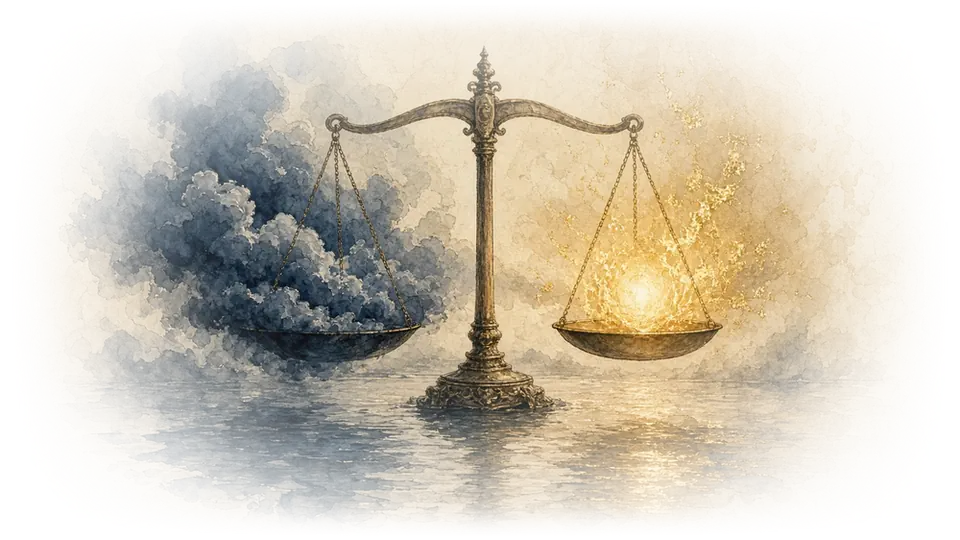
The Teivah is a hint. Its three stories form a lamed, the “tongue” of a scale. Sefer Yetzirah links lamed to Tishrei, whose sign is Moznayim (the scales). Its dimensions, 300 × 50 × 30, spell ש-נ-ל, which rearranges to לשון, “tongue.”
“G‑d is considering dropping the entire project had it not been noah” (~32:03)
The Mabul as kindness; the arrogance of “external wisdom” (~36:47–41:29)
מבול = 78 = חסדו, “His kindness” (the captions read “hasto”). The Zera Kodesh says it was a great kindness to remove a generation that was brilliant in secular wisdom (“chochmos chitzonios”) but arrogant, and that “deceived” the world. Here Wolf adds a personal aside about “today.”
He hedges (“I’m not forming and giving my opinions because I am still in the dark”) and closes with a prayer that the truth simply be “exposed,” “we don’t need any flood.”
“you see today as well some kind of a deception on the name of science everything is the name of science the name of medicine” (~39:55)
The Bnei Yissaschar: Terach’s family fixed the fig tree (~41:59–51:29)
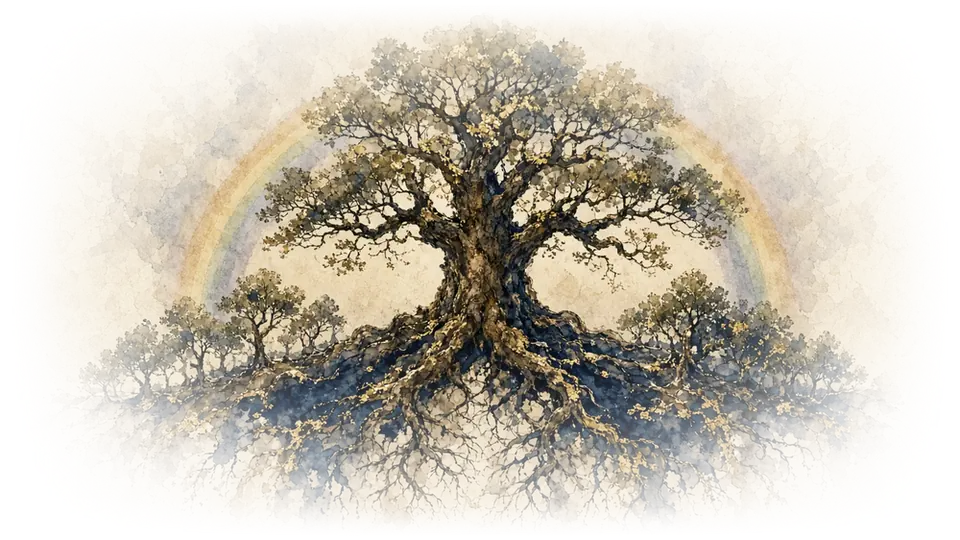
In the name of an early source, the Bnei Yissaschar says the Etz HaDaas (Tree of Knowledge) was a fig, תאנה. Its letters stand for Terach (ת) and his sons Avraham (א), Nachor (נ) and Haran (ה). The whole family took part in the repair:
- Through Nachor: Rivkah, then Rachel and Leah.
- Through Haran: Sarah, Milkah, and Lot. Through Lot came Moab, then Ruth, David and Mashiach.
The extra word “es” with each birth (“he fathered es Avram, es Nachor, es Haran”) hints at what was “born along with them”: “the salvation and the rectification... of all of the world.”
“this family which was initial sin needed this family to fix it” (~48:50)
Why the Torah hides Avraham’s furnace: a “sin for the sake of Heaven” (~51:29–1:02:43)
Content note: this part is for adults and covers mature themes.
The Bnei Yissaschar gives two answers.
- No reward: Avraham’s service was pure, with no reward attached; he was drawn “like a spark is drawn to the flame.”
- No permission: as a non-Jew before Sinai, Avraham had no mitzvah of martyrdom (kiddush Hashem is a Jewish commandment), so letting himself be thrown in was technically forbidden, a kind of self-destruction. The soul, though, can sense “what G‑d really really really wants.” Wolf compares it to Pinchas and to the Rebbe Rayatz sending young men into Soviet Russia at mortal risk. It was a sin committed for Hashem’s honor (aveirah lishmah, Nazir 23b [reference added]), which is why the Torah could not record it. He also cites Yael and Sisera, and David’s readiness to worship an idol (Sanhedrin 107a [reference added]). He warns strongly: “no one should G‑d forbid use this if this is not 100 sure... absolutely unacceptable.”
He ends with the Bnei Yissaschar’s line that even if every mitzvah earned Gehinnom and every sin earned Gan Eden (the Garden of Eden), “we would choose to do the mitzvahs because they’re G‑d’s commandment.” Avraham was saved “in the merit of Yaakov,” the attribute of truth.
“even if we were to know that the... consequences for every mitzvah is a burning hell and the consequence for every sin is eternal ecstasy... we would choose to do the mitzvahs” (~1:00:29)